

When you request a quote for a plastic injection mould, one of the first decisions your mould maker will ask you to make is: hot runner or cold runner? This single choice affects mould cost, part quality, production speed, material waste, and long-term maintenance — sometimes by tens of thousands of dollars. In this hot runner vs cold runner guide, we break down how each system works, compare them across six critical dimensions, and give you a clear framework for choosing the right one for your project.
Table of Contents
- What Is a Runner System in Injection Moulding?
- How Cold Runner Moulds Work
- How Hot Runner Moulds Work
- Hot Runner vs Cold Runner: 6-Factor Comparison
- When to Choose Cold Runner
- When to Choose Hot Runner
- The Hybrid Option
- FAQ
What Is a Runner System in Injection Moulding?
In injection moulding, molten plastic travels from the machine nozzle through a channel called the runner before reaching the mould cavities where the actual parts are formed. The runner system is the plumbing of the mould — its design directly determines how many parts you can produce per cycle, how much plastic is wasted, and how consistently each part fills.
There are two fundamental approaches: cold runner, where the runner channel solidifies along with the parts and is ejected as waste, and hot runner, where the runner is kept molten by electric heaters so no runner waste is produced. Understanding the trade-offs between hot runner vs cold runner is essential for optimising both part cost and mould investment.
How Cold Runner Moulds Work
A cold runner system is the traditional, simpler approach. The molten plastic enters the sprue, flows through the runner channels (usually in a two-plate or three-plate mould configuration), and fills the cavities. After each cycle, the entire system — sprue, runners, and parts — cools and is ejected together. The solidified runner waste must then be separated from the parts, reground, and either recycled back into the process or discarded.
Cold runner moulds use a two-plate design (simplest, runner and parts eject from the same parting line) or a three-plate design (runner separates automatically from parts via a second parting line, allowing gating on any surface of the part). Three-plate moulds cost 15–25% more but offer greater gate flexibility.
Advantages of Cold Runner Systems
- Lower mould cost: Cold runner moulds are 20–40% cheaper than hot runner moulds because they require no heaters, manifolds, or temperature controllers. For a simple 4-cavity mould, this can mean USD 3,000–8,000 in savings. Learn more about injection mould cost factors.
- Simpler maintenance: With no electrical components inside the mould, cold runner systems rarely break down. Maintenance is limited to standard cleaning and occasional runner channel polishing.
- Material flexibility: Cold runners work with virtually any plastic material, including engineered resins, glass-filled compounds, and thermally sensitive materials that may degrade in a hot runner.
- Faster startup: No need to wait for heaters to reach operating temperature. Production can start within minutes.
- Easier colour changes: Purging the runner system for a colour change is straightforward since the entire runner is ejected each cycle.
Disadvantages of Cold Runner Systems
- Material waste: Every cycle produces runner waste equal to 15–40% of the total shot weight. For high-volume production, this waste adds up significantly.
- Longer cycle time: The runner must cool and solidify before ejection, adding 2–8 seconds per cycle compared to a hot runner.
- Post-processing required: Runners must be separated from parts manually or with a robotic picker, then reground — adding labour and equipment costs.
- Recycled material quality: Reground runner material can cause variations in part colour, strength, and dimensional stability, especially in engineering-grade resins.
How Hot Runner Moulds Work
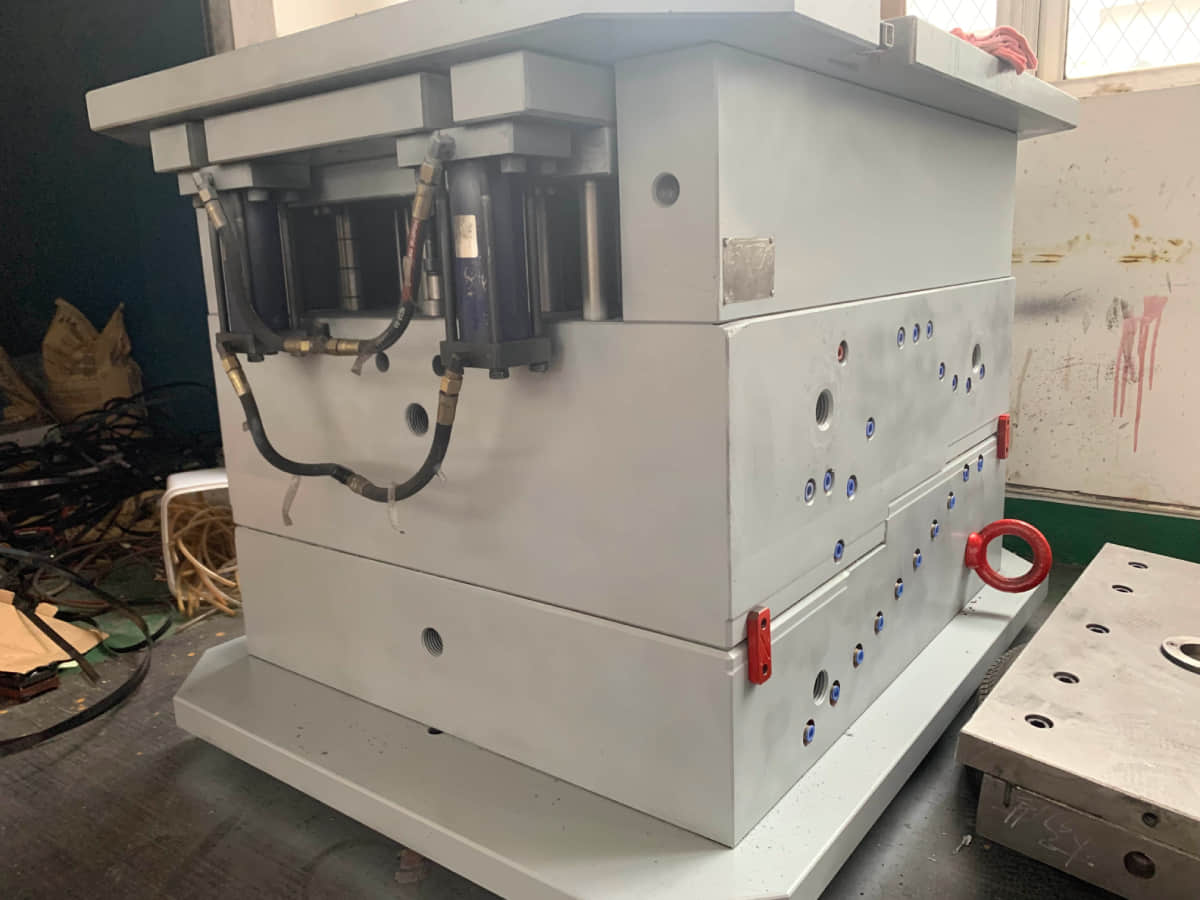
A hot runner system keeps the plastic in the runner channel molten at all times using electric cartridge heaters and a temperature controller. The system consists of a manifold (the main distribution channel), nozzles (which deliver plastic to each cavity), and a temperature controller that maintains precise heat zones. Because the runner never solidifies, only the parts are ejected — no waste, no separation step.
Hot runner systems come in two main configurations: internally heated (torpedo probes inside the runner channel, lower cost but less uniform heat) and externally heated (heaters wrapped around the manifold, more uniform temperature and preferred for most applications). For multi-cavity moulds — like the 16-cavity cutlery moulds we build at TW Mold — hot runners are almost always the better choice.
Advantages of Hot Runner Systems
- Zero runner waste: All plastic goes into parts. No reground material, no waste disposal. For a 16-cavity mould producing 50,000 shots, eliminating 20g of runner per cycle saves 1,000 kg of plastic per production run.
- Faster cycle times: Without waiting for runners to cool, cycle times drop by 15–30%. In high-volume production, this can increase output by thousands of parts per day.
- Better part quality: Precise temperature control at each nozzle means consistent fill pressure, fewer flow marks, and better surface finish. Gate vestige is minimal with valve gate technology.
- Automation-friendly: Since only parts are ejected, robotic pickers can grab parts directly — no need to sort runners. Ideal for fully automated production lines.
- Lower long-term cost: Despite higher initial investment, the savings in material waste and faster cycle times typically pay back the hot runner cost within 50,000–100,000 shots.
Disadvantages of Hot Runner Systems
- Higher initial cost: A hot runner system adds USD 2,000–15,000 to mould cost, depending on the number of nozzles and controller sophistication. Premium systems like Mastip, Synventive, or Yudo can push this even higher.
- Thermal sensitivity: Some materials — particularly PVC, certain POM grades, and UV-stabilised resins — may degrade if held at melt temperature in the manifold for extended periods.
- Maintenance complexity: Heaters, thermocouples, and valve gates can fail. Replacement requires disassembling part of the mould. A single nozzle failure can halt production for hours.
- Colour change difficulty: Purging the manifold for a colour change takes longer and may require chemical purge compounds. Not ideal for short-run, multi-colour production.
- Startup time: Heaters need 10–20 minutes to reach stable temperature before the first shot. This is negligible for long runs but wasteful for short production batches.
Hot Runner vs Cold Runner: 6-Factor Comparison
| Factor | Cold Runner | Hot Runner |
|---|---|---|
| Mould Cost | Lower (baseline) | +USD 2,000–15,000 |
| Material Waste | 15–40% per shot | 0% (no runner) |
| Cycle Time | +2–8 sec for runner cooling | Baseline (15–30% faster) |
| Part Quality | Good, with gate vestige | Excellent, minimal gate mark |
| Maintenance | Low, no electronics | Moderate, heaters/valves can fail |
| Break-even Volume | Best under 50K shots | Best above 50K–100K shots |
When to Choose Cold Runner
A cold runner system is the right choice when:
- Production volume is low (under 50,000 total shots). The higher cost of a hot runner will not be recovered through waste savings.
- Budget is the primary constraint. For startups or small-batch buyers, the 20–40% mould cost savings matters more than long-term efficiency.
- The material is thermally sensitive. PVC, certain POM grades, and some UV-stabilised resins degrade in hot manifolds.
- Parts require frequent colour changes. If you run multiple colours in short batches, cold runners allow fast purging between runs.
- Part geometry is simple with generous gate allowance. Decorative or visible-surface parts may benefit from hot runner’s cleaner gating, but structural parts often don’t need it.
For prototyping and bridge tooling, cold runner aluminium moulds are almost always the right call — the low volume and short lifespan make hot runner investment unnecessary.
When to Choose Hot Runner
A hot runner system pays off when:
- Production volume is high (over 100,000 shots annually). Material savings alone can recover the system cost within months.
- Multi-cavity moulds (8, 16, 32+ cavities). Managing runners across many cavities with a cold system creates excessive waste and unbalanced flow. Hot runners ensure each cavity fills identically.
- Part requires premium surface finish. Valve-gated hot runners leave a tiny, clean gate mark — essential for visible surfaces on consumer products, thin wall food containers, and furniture.
- Material is expensive. If you are moulding PC, PEEK, or specialty engineering resins at USD 5–20/kg, eliminating 30% runner waste has massive financial impact.
- Production is automated. Robotic pickers work best when they only handle parts, not runners.
The Hybrid Option
Many moulds use a hybrid approach — a hot runner main manifold feeding into cold sub-runners. This reduces waste compared to a full cold runner system while keeping mould cost below a full hot runner. It is particularly useful for:
- Parts where the cavity layout requires runners that a hot manifold cannot easily reach
- Multi-family moulds (different parts in one mould) where each cavity needs different gating
- Budget-conscious projects that still want to reduce waste
At TW Mold, we use Moldex3D flow simulation to determine the optimal runner configuration before cutting steel. This ensures balanced flow across all cavities regardless of the system chosen. Learn about our mould flow analysis service.
Frequently Asked Questions
What is the main difference between hot runner and cold runner moulds?
In a cold runner mould, the plastic in the runner channel solidifies with each cycle and is ejected as waste. In a hot runner mould, electric heaters keep the runner channel molten at all times, so only the parts are ejected. Hot runners cost more upfront but eliminate waste and reduce cycle time, while cold runners are cheaper to build and simpler to maintain.
How much does a hot runner system cost?
A hot runner system typically adds USD 2,000 to 15,000 to mould cost, depending on the number of nozzles, manifold complexity, and controller type. Entry-level systems from Chinese brands like Yudo or Annte start around USD 2,000–5,000, while premium systems from Mastip or Synventive can cost USD 8,000–15,000+. The investment is usually recovered through material savings within 50,000 to 100,000 shots.
Which is better for multi-cavity moulds: hot runner or cold runner?
Hot runner is strongly preferred for multi-cavity moulds (8+ cavities) because it eliminates the large volume of runner waste that a cold system would produce and provides balanced, consistent fill to every cavity. For 16 or 32-cavity moulds — such as cutlery or thin wall container production — a hot runner is almost always the correct choice.
Can I switch from cold runner to hot runner later?
It is technically possible to retrofit a cold runner mould with a hot runner system, but it is rarely cost-effective. The retrofit requires re-machining the mould base, installing a manifold plate, drilling new runner channels, and adding nozzle seats. The cost is typically 60–80% of building a new hot runner mould from scratch. It is better to decide the runner system during the initial mould design phase.
Does TW Mold offer both hot runner and cold runner moulds?
Yes. At TW Mold in Taizhou Huangyan, we manufacture both hot runner and cold runner injection moulds based on each project’s requirements. We use hot runner systems from Yudo, Mastip, and Annte, and we run Moldex3D flow simulation before machining to recommend the optimal runner configuration. Contact us with your project details for a tailored recommendation.
Conclusion
The hot runner vs cold runner decision comes down to volume, material, and budget. If you are producing fewer than 50,000 shots or working with thermally sensitive materials, a cold runner mould is the pragmatic choice. If you are running high-volume production with 8+ cavities and expensive resin, a hot runner system will pay for itself and then save you money for years.
The best way to decide is to discuss your production forecast, part geometry, and material with an experienced mould manufacturer. At TW Mold, we provide free mould flow analysis and runner system recommendations as part of every project quote. Send us your 3D model and production requirements — we will tell you which system fits best and why.